
SQL vs NoSQL: Understanding the Trade-offs Before Choosing a Database

Have you ever been in a situation where you had to choose between SQL and NoSQL? Or are you planning to build an application but struggling to decide on which database to choose? What are the trade-offs you consider before you decide on choosing the right database for your use case? Let’s dive into it.
A database is the backbone of any application, and choosing the right database is one of the most important technical decisions. While selecting the database, there is no single right choice, but it comes with trade-offs, and as a designer, you have to make the best decision as per your application’s needs.
SQL (Structured Query Language) or Relational databases are simple tables that consist of rows and columns. It always has a fixed structure and supports the relationship between tables. SQL databases also ensure data consistency and integrity with their ACID property. Examples: MySQL, PostgreSQL.
NoSQL, on the other hand, supports flexible Data formats and even semi-structured and non-structured data. It provides the flexibility and eliminates the overhead of relational databases by providing a quick data store and accessibility. Example: MongoDB, Amazon DynamoDB.
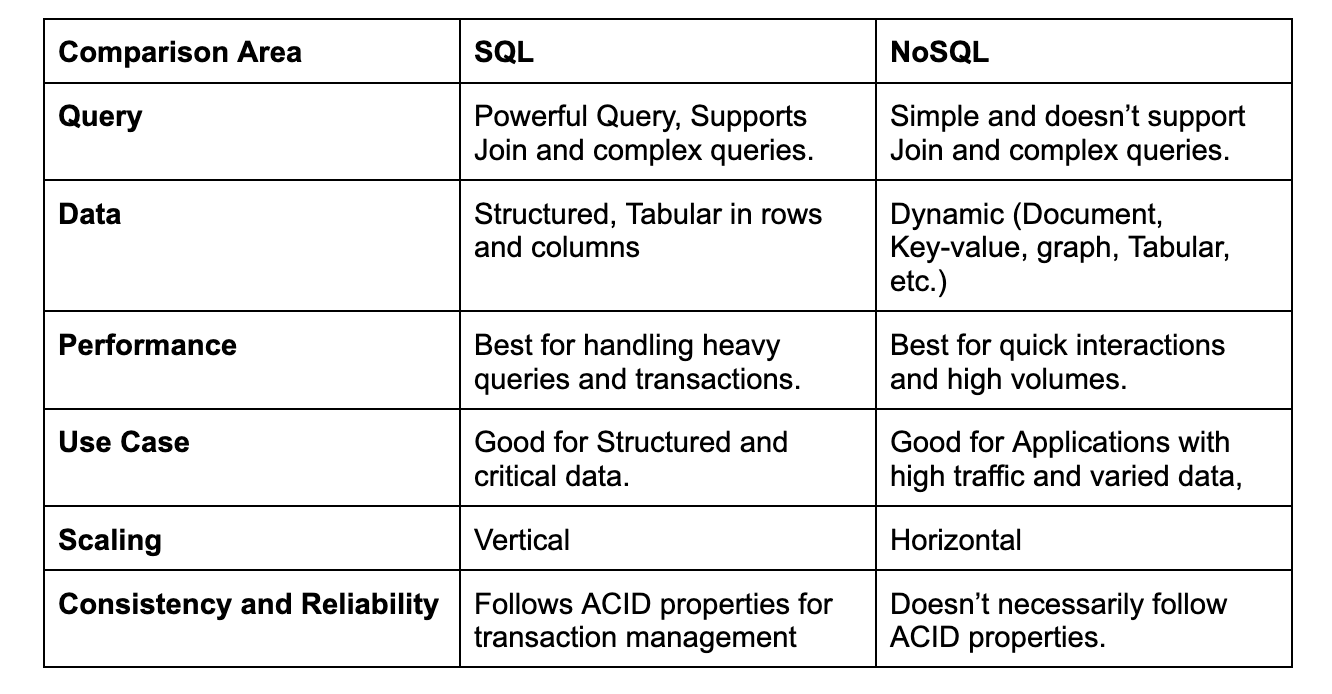
Now, let's have a comparison of different areas.
Example 1: Banking App
Let’s assume a simple use case where the user can log in to the Banking app, access their accounts, and make some transactions. In this use case:
There must be a strong consistency and reliability of transactions.
Money must be correctly reflected after the transactions (Success, Failed, Pending, etc.).
A clear relationship should be defined.
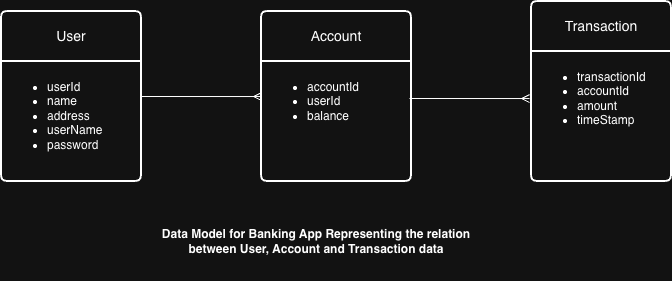
Based upon the above use cases, I would go with SQL Database for this Banking App.
Example 2: Social Media App
A Simple Social media App where:
Profile changes frequently.
Millions of reads and fast load.
Easy Scaling.
User Profile (JSON)
{
userName,
name,
bio,
posts[],
friends[],
likes[]
}
Based upon the above use cases, I would go with a NoSQL database for this Social Media App.
To conclude, for the best engineering design, we choose what fits our problem and not the trends.